Case study · Beauty Technology
How Do You Put Professional-Grade Beauty Technology Into the Palm of Your Hand?
Three energy-based technologies. Different performance requirements. Different treatment behaviors. One integrated product.
Three treatment energies · one device
RF
Bipolar · 639 kHz
EMS
Pulse train · 3 Hz
RED LIGHT
660 nm ± 5 nm
Product
SKINSCULPT
RF · EMS · Red Light
Product
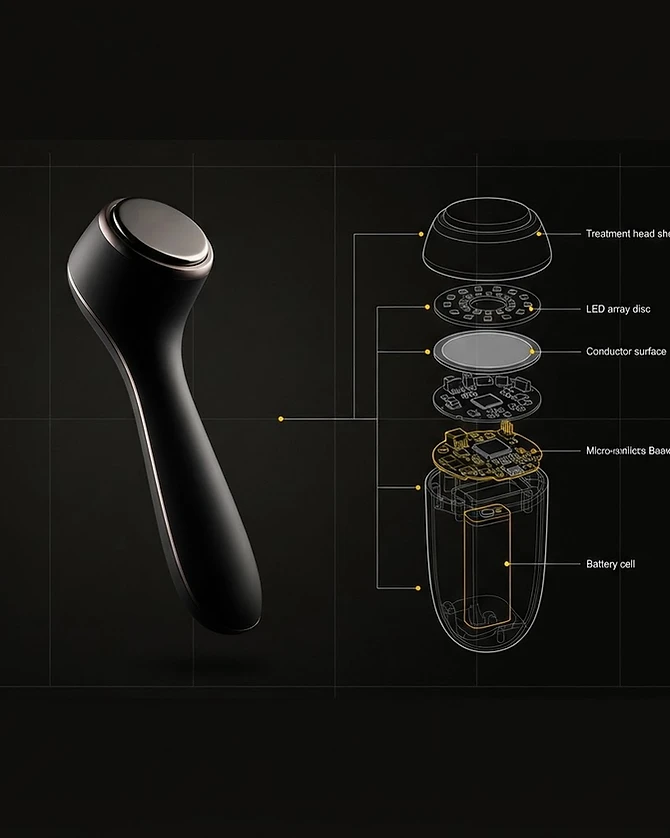
SkinSculpt by Clarisonic — 3-in-1 body treatment device
Architecture
Bipolar RF 639 kHz · EMS 3 Hz · RLT 660 nm — three independent treatment modes
Disciplines
Industrial Design · Electrical Engineering · Human Factors · Manufacturing
Scope
Industrial design & engineering → tooling → validation → mass production
The market tension
More features don't automatically create a better product.
Multi-function beauty devices are often marketed around the number of technologies they can activate or combine.
But adding features creates an engineering question: what happens to the performance of each function when multiple energy-demanding technologies share the same compact power architecture?
Marketing thinking
More technologies running together = more value.
Engineering thinking
What operating conditions does each technology actually need to perform as intended?
The question we ask first
Are we optimizing for the number of features — or for the performance of each feature?
This is a question about product architecture — not about any specific device or brand. We make no claims about the effectiveness of other products; we simply believe the deeper question is the one worth answering.
01 / The tension
The easy version of a 3-in-1 is three devices sharing one shell.
The central question wasn't how to fit three treatment technologies into one product. It was how to integrate them without compromising the performance of each. That single sentence turns a packaging problem into a systems problem — one where every mode is either engineered under its intended conditions, or quietly averaged away.
T01
High-demand technologies don't share politely
Radio Frequency, EMS and Red Light are each electrically demanding. Operating several of them simultaneously from the same compact electrical architecture can require the available output to be shared between functions — and shared output is compromised output.
T02
A feature list is not an architecture
The conventional answer to a 3-in-1 is to switch everything on at once and call it more. If the system can't support each technology under its intended electrical conditions, the marketing claim outruns the engineering.
T03
It still has to feel like one product
Three modes, one hand, one routine. The user should never sense the electrical negotiation happening inside — the device should simply feel like a single, coherent object with a clear choice at any moment.
02 / The decision
The boldest decision was what the product would refuse to do.
SkinSculpt operates RF, EMS and Red Light Therapy as independent treatment modes — never all three simultaneously. The engineering rationale: running multiple high-demand technologies at once from the same compact electrical architecture can require the available electrical output to be shared between functions. Instead, each treatment was designed to operate independently, under its intended electrical conditions.
The conventional answer
All three at once
Shared output · averaged conditions
The engineered answer
One mode at a time
Each mode under its intended conditions
Fewer simultaneous claims, more engineering honesty — each mode is a complete treatment, not a fraction of three.
Industrial design language
The form follows the architecture. A slender neck transitions to a wider conductor head — the silhouette reflects a champagne-bottle profile, where the geometry of each section is dictated by the electrical and ergonomic function it houses.
Engineering rationale
The wider treatment head accommodates the larger conductor diameter (4.5 vs 3.0 on the reference device) and the LED array — form dimensions are a direct consequence of the electrical architecture inside.
Gizmospring publishes only verified engineering positions. This account reflects the project's stated development rationale — no clinical performance is claimed.
The three systems · side by side
Three Technologies Don't Behave the Same Way.
RF
01Bipolar Radio Frequency
Historical design specification
639 kHz
Three energy levels
65V · 75V · 85V
EMS
02Electrical Muscle Stimulation
Historical design specification
3 Hz
Three levels
25V · 30V · 35V
RLT
03Red Light Therapy
Historical design specification
660 nm ±5 nm
Output
50 mW/cm²
Integrating these into one product required more than placing three features inside the same housing. Each technology creates different requirements around the dimensions below — and every one of those requirements had to be reconciled within a single compact device.
Electrical architecture
Control
Treatment interface
User behavior
Integration starts by respecting what makes each technology different.
The architectural decision
Provisional · pending engineering verificationIntegration Doesn't Have to Mean Everything at Once.
The Gizmospring team recalls that an important architectural decision was allowing RF, EMS and Red Light Therapy to operate as independent treatment functions rather than simultaneously.
The engineering rationale was to allow the selected treatment technology to receive the electrical conditions required for its intended performance — rather than sharing available output across multiple simultaneously operating functions.
If verified · the published claim
Three technologies in one device. One technology given priority at a time.
Before publishing · verification requested
Original electronics engineering team
Only after this review should the claim above become a public case-study position. Until then, it is presented as the team's recollection — not as verified engineering fact.
We optimized around treatment performance — not the marketing appeal of turning everything on at once.
03 / Independent modes
Three Technologies. Three Independent Treatment Modes.
SkinSculpt integrates RF, EMS and Red Light Therapy into a single product platform — but it does not require all three technologies to operate simultaneously. The architecture allows each treatment to be used independently.
Shared-power reality
When multiple electrical functions operate simultaneously, the product's available power and electrical architecture must accommodate their combined demands.
SkinSculpt's decision
SkinSculpt instead prioritized operating each technology independently, under its intended conditions — never averaged across a shared load.
RF & EMS behavior · gliding
The user moves the treatment head continuously over the treatment area — energy delivered across a moving surface.
RLT behavior · stationary hold
With microcurrent, the user holds the treatment surface stationary for 1–2 minutes per area — a completely different gesture.
The three technologies didn't just draw different power — they asked for different user behaviors. A single simultaneous session could not have served both.
Integration doesn't have to mean simultaneous operation. Sometimes better integration means giving each technology what it needs.
Mode 01
RFBipolar Radio Frequency
Delivers radio-frequency energy to the treatment area — run as its own complete mode, under its intended electrical conditions.
Bipolar RF · 639 kHz
Three settings · 65 V / 75 V / 85 V
Mode 02
EMSElectrical Muscle Stimulation
Delivers precisely timed electrical pulses as an independent treatment — never competing with another mode for output.
Pulse frequency · 3 Hz
Three settings · 25 V / 30 V / 35 V
Mode 03
RLTRed Light Therapy
Emits red light onto the treatment surface as a standalone mode with its own operating conditions.
Wavelength · 660 nm ± 5 nm
Output · 50 mW/cm²
Microcurrent · 13 V / 3 Hz (±10%)
The treatment interface
More Coverage With Every Pass.
Product performance isn't only determined by electrical output. The physical treatment interface also affects how the user experiences the routine.
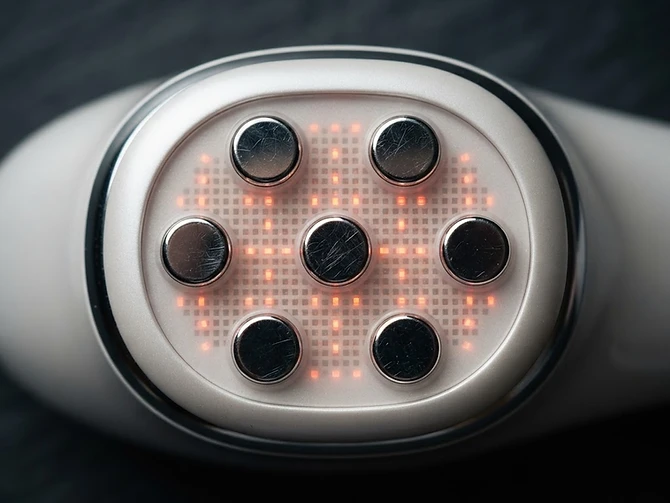
Historical product materials identify a 4.5 conductor diameter — compared with 3.0 on the benchmark device evaluated during development.
Design intention · supplied by Gizmospring
A larger treatment surface was intended to increase coverage and reduce the amount of repetitive movement required across a treatment area.
Smaller contact area
More passes required
A smaller footprint covers less area per pass, requiring more repetitive movement across the treatment area.
Larger contact area
Greater area covered per pass
A larger treatment surface was intended to increase coverage with each movement across the treatment area.
Geometry figures are published as historical product materials. No specific reduction in treatment time is claimed — that would require testing data, which does not exist in the project record.
Performance matters. So does how long people need to use it.
Human factors
Ergonomic decisions pending verificationOne Device Had to Support Two Completely Different Ways of Using It.
The technologies did not only have different electrical requirements — they required different physical interactions.
RF / EMS
Gliding movement
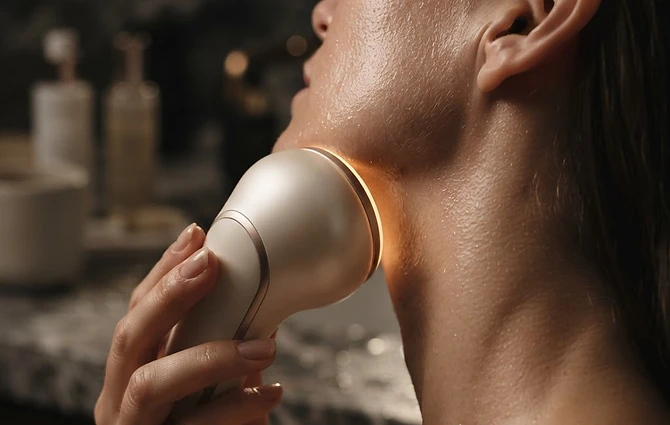
The historical usage instructions called for the device to be placed against the treatment area and glided upward and outward across areas such as the jaw, forehead and neck.
Historical usage instructions
RLT
Stationary hold
The historical instructions called for the device to be held stationary for 1–2 minutes on each treatment area.
Historical usage instructions
One device must feel comfortable and controllable during movement — while also remaining comfortable when held stationary.
Designed around two behaviors · verification requested
Original industrial design & engineering team
Handle geometry
F1What handle shape serves both a hand in motion and a hand holding still?
Awaiting design-record confirmation
Weight distribution
F2How should mass be arranged so the device feels controlled while gliding and light while held in place?
Awaiting design-record confirmation
Head angle
F3At what angle does the treatment head meet the treatment area without straining the wrist in either behavior?
Awaiting design-record confirmation
Contact area
F4How large should the treatment interface be to stay effective in motion and stable at rest?
Awaiting design-record confirmation
Grip
F5How does the gripped surface remain secure through repeated movement and through minutes of continuous holding?
Awaiting design-record confirmation
Controls
F6Where do the controls sit so they can be operated mid-glide and found mid-hold?
Awaiting design-record confirmation
Balance
F7How is overall balance tuned so the device doesn't tip away from the treatment area in either behavior?
Awaiting design-record confirmation
The specific ergonomic decisions — geometry, distribution, angle, grip detailing and control placement — are not asserted here. They will be published only as the original design team confirms them from the project record.
One product. Different technologies. Different behaviors. One intuitive form.
Design story
Engineering Performance Without Looking Clinical.
Although SkinSculpt contained sophisticated energy-based technologies, the product was intended for the home — not a treatment room.
The industrial-design inspiration drew from the proportions and elegance of a champagne bottle — a slender body transitioning toward the larger treatment conductor.
01
Champagne silhouette
02
Form studies
03
SkinSculpt
What the direction achieved
This aesthetic direction helped transform technical hardware into a premium consumer beauty experience — a device that belongs on a vanity, not beside clinical equipment.
Professional technology doesn't have to look like professional equipment.
The architecture of integration
The Challenge Wasn't Putting Three Technologies Inside.
It Was Making All Three Belong There.
Performance
RF / EMS / RLT engineered around their individual requirements.
Coverage
Larger treatment interface designed to cover more area.
Usability
One form supporting both gliding and stationary treatment behaviors.
Desirability
Premium consumer-product design rather than clinical equipment.
SKIN
SCULPT
SKINSCULPT
The best multi-function products don't simply contain multiple technologies. They integrate them into one coherent experience.
04 / Power as a constraint
Power is a design constraint.
Integrating multiple technologies into a handheld beauty device means negotiating six immovable limits at once: available voltage, available current, total power, battery architecture, heat and physical size. Every one of them pushes back on every other one.
The engineering work is not switching technologies on — it is resolving what they need to work properly inside the same sealed, hand-held, battery-driven volume.
C01
Available voltage & current
Every function draws from the same finite electrical budget. What one technology takes, another cannot.
C02
Battery architecture
A handheld device carries a fixed energy reserve. Cell choice, discharge behavior and recharge expectations bound what the platform can deliver.
C03
Heat
Energy that cannot be delivered to the treatment area has to go somewhere — and in a handheld device, that somewhere is the user's hand.
C04
Physical size
A larger power system means a larger device. Beauty form factors tolerate neither the bulk nor the weight of over-provisioned electronics.
Simultaneous architecture
Available electrical resources distributed across multiple active functions — each technology receiving a share of what it was designed to receive in full.
SkinSculpt approach
Electrical resources prioritized around the selected treatment mode — one technology receiving its intended operating conditions at a time.
Verified electrical specifications
Confirmed from historical project materials
V/01
Bipolar RF output
639 kHz · 65 V / 75 V / 85 V — three settings
V/02
EMS output
3 Hz · 25 V / 30 V / 35 V — three settings
V/03
Red Light Therapy output
660 nm ± 5 nm · 50 mW/cm² · microcurrent 13 V / 3 Hz (±10%)
V/04
Mode architecture
Independent modes — each under intended conditions
Engineering data still requested
Awaiting verification · no figures published without confirmation
P/04
Battery architecture
Pending
P/05
Power-supply architecture
Pending
P/06
Simultaneous-load scenarios
Pending
P/08
Thermal constraints
Pending
Published specifications are confirmed engineering values — everything else stays pending until Gizmospring verifies it. No fabricated figures, no arbitrary graphics.
The question wasn't how many technologies could be switched on. It was how each technology could be engineered to perform properly.
05 / Coverage as a design objective
Performance isn't only about power. It's also about coverage.
A second objective shaped the product from the start: reducing the burden of treatment time. SkinSculpt therefore used a larger treatment surface, intended to cover more area during each pass — trading a bigger engineering problem for a shorter routine.
Small treatment area
More passes
Longer routine
Larger treatment area
Greater coverage
Potentially fewer passes across the target area
Verified dimension · historical comparison materials
Treatment-head conductor diameter: 4.5 vs 3.0 on the comparison device — an engineering dimension, not a performance claim.
Increasing treatment area does not come free. It multiplies the engineering and human-factor questions the platform has to answer — each one a constraint the larger surface creates.
A
Energy distribution
Spreading the same output across a larger surface means each technology must still deliver its intended effect across the whole contact area — not just at its center.
B
Contact consistency
A larger head must maintain even skin contact across its surface. Gaps, tilting or uneven pressure degrade treatment quality.
C
Ergonomics
The surface has to stay reachable and controllable across facial contours — coverage only counts if the user can hold and guide it correctly.
D
Device size & weight
A larger treatment surface pushes the rest of the device outward. Every added millimeter and gram lands in the user's hand.
E
Thermal management
A bigger active area is a bigger thermal area — heat has to be managed across the surface, not concentrated in one spot.
F
Treatment-head geometry
The head's shape decides how the surface follows the target area. Geometry, coverage and comfort resolve together or not at all.
Considerations listed per the project team — no treatment-time reduction figures are claimed without validated measurement.
A treatment only creates value if people are willing to complete it.
06 / Three objectives, one product
The product had to optimize three things at once.
Not sequentially. Not as separate devices. All three, inside the same product, at the same time.
Performance
Give each technology the electrical conditions it requires.
Versatility
Integrate RF, EMS and Red Light Therapy into one product.
Usability
Increase treatment coverage and create a practical at-home routine.
The challenge wasn't adding three technologies. It was making three technologies coexist in one product without losing sight of why each one was there.
07 / Architecture vs. experience
Complex technology. Simple decisions.
SkinSculpt contains three different treatment technologies — but the user experience should not expose the complexity of the underlying architecture. The product should allow the user to select the desired treatment and interact with the device intuitively.
Inside
RF + EMS + LEDs + electronics + power + thermal + safety
Seven engineering domains negotiated into one sealed, handheld volume.
Outside
Select. Treat. Repeat.
The entire interaction the user is asked to learn. Everything else is the product's problem, not the user's.
Experience design scope — per project team
Interface details pending verification · no features invented
UX/01
Treatment selection
Pending
UX/02
Controls
Pending
UX/03
Indicators
Pending
UX/04
Treatment modes
Pending
UX/05
Ergonomic decisions
Pending
UX/06
Contact surfaces
Pending
UX/07
Feedback
Pending
UX/08
Safety logic
Pending
How each of these is implemented will be documented exactly as verified by the project team. We do not describe interface features we cannot confirm.
Good product architecture manages complexity. Good experience design makes it disappear.
04 / The efficiency objective

Efficiency isn't a spec sheet number. It's a shape.
Alongside the three-mode architecture, a second objective shaped the product: treatment efficiency. SkinSculpt carries a larger treatment surface than a compact form would suggest — increasing coverage and reducing the time required to treat a given area.
More coverage per pass
A larger treatment surface treats more area in a single pass — coverage becomes a geometry decision, not a marketing one.
Less time per area
Increased coverage reduces the time required to treat a given area — efficiency engineered into the physical form, not the instructions.
Efficiency as respect for the user
Treatment time is a user cost. The device was shaped to pay that cost down through its own architecture.
05 / Designed to be lived with
The mode switching should disappear from the user's attention.
Beauty devices don't live in laboratories. SkinSculpt lives in bathrooms, in routines, in a few quiet minutes of a day — so the human-factors objective was that the electrical discipline inside never reaches the hand. One mode, one gesture, one clear choice: the complexity of the system expresses itself as simplicity of use.

08 / The Gizmospring development journey
From product strategy to production.
Six stages, one team. The same hands that framed how the technologies should coexist carried the product through engineering, validation and the factory floor.
ST-01 · PRODUCT ARCHITECTURE
Stage 1 / 6Determine how the three technologies should coexist.
ST-02 · INDUSTRIAL DESIGN
Stage 2 / 6Create a usable handheld form around the treatment requirements.
ST-03 · ENGINEERING
Stage 3 / 6Integrate RF, EMS, Red Light, electronics and mechanical architecture.
ST-04 · PROTOTYPING
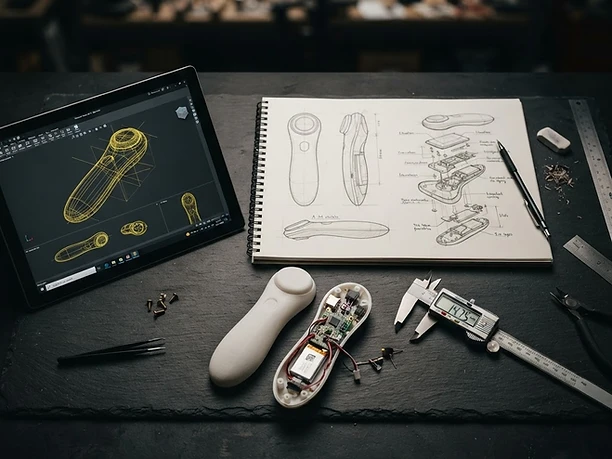
Stage 4 / 6Convert assumptions into physical evidence.

ST-05 · VALIDATION
Stage 5 / 6Verify product performance, reliability and safety against actual project requirements.
ST-06 · TOOLING & MANUFACTURING
Stage 6 / 6Translate the validated architecture into repeatable production.
We didn't hand off the idea after strategy. We stayed with it until it became a product.
06 / From system idea to mass production
One system, carried all the way to the factory floor.
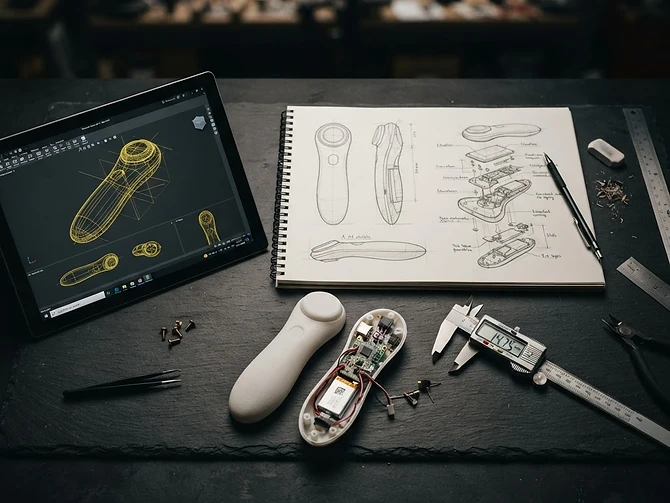
The trade-off thinking didn't stop at the render. Gizmospring developed SkinSculpt from industrial design and engineering through tooling, validation and mass production — the electrical discipline of the three-mode architecture had to hold through every one of those stages.
ST-01
Industrial design & engineering
The system was defined and resolved as one architecture — form, modes, electronics and thermals developed together.
ST-02
Tooling
The design was carried into production tooling — the geometry that made engineering sense had to survive the realities of mold-making.
ST-03
Validation
The integrated device was verified through the development program so each mode behaved as intended in the production form.
ST-04
Mass production
The product shipped to production — the same integrated system, built at scale.
07 / The outcome
Three Technologies. One Purposeful Platform.
The verified outcome of the program — integration as an engineering position, carried from architecture to mass production.
01 / Verified outcome
ConfirmedOne premium at-home device
SkinSculpt integrated RF, EMS and Red Light Therapy into one premium at-home beauty device.
02 / Verified outcome
ConfirmedIndependent treatment modes
The architecture used independent treatment modes rather than relying on simultaneous activation of all three functions.
03 / Verified outcome
ConfirmedA larger treatment surface
A larger treatment surface was designed to provide greater coverage and support a more practical treatment routine.
04 / Verified outcome
ConfirmedSupported end-to-end
Gizmospring supported the product through industrial design, engineering, tooling, validation and mass production.
Quantitative evidence · to investigate with the project record
Published only where verified
Gizmospring publishes only verified figures. Historical product materials also contain treatment-efficacy claims — none are reproduced here without regulatory or scientific substantiation. This ledger will be completed as project records are confirmed.
The transformation
Professional Technology. Designed for Home.
Three distinct energy-based technologies
RF, EMS and Red Light Therapy — each with its own electrical requirements and its own treatment behavior.
One integrated electrical and mechanical architecture
Independent modes, engineered so each technology operates under its intended conditions.
A larger treatment interface
More coverage with every pass, without sacrificing contact consistency or ergonomics.
One premium handheld experience
A consumer product — not clinical equipment — supporting both gliding and stationary use.
Tooling, validation and mass production
Carried from industrial design through engineering, tooling, validation and into volume manufacturing.
SkinSculpt was developed by Gizmospring from industrial design and engineering through tooling, validation and mass production.
The goal wasn't to put more technology into a beauty device. It was to make sophisticated technology practical enough to become part of an everyday routine.
08 / What this project demonstrates
SkinSculpt challenged the conventional feature-driven answer to a multi-technology product. Instead of activating everything at once, the system was engineered around performance, usability and system-level trade-offs — and carried through tooling, validation and mass production.
The hardest integration decisions aren't about adding technologies. They're about refusing to let one compromise another.
Trying to integrate multiple technologies into one product? Let's talk.
Start a conversation