Case Study · Hair & Scalp Care
What If a Comb Could Solve More Than Tangles?
Research revealed that the opportunity was bigger than the original brief—leading Gizmospring and NION to rethink the everyday comb as a more versatile hair and scalp-care platform.
Product
BLISS · NION
Capability tags
 Fig. 01 · BLISS render · project documentation
01 / Project record
The Facts, As the Record States Them.
Year
2022
Client
NION
Category
Beauty Device
Designed by
Gizmospring
Team
Kenny Tai, Esme Lo, Anson Lee, Lisa Chen, Macy He, Vivian Chu
Documentation
Public project record — property belongs to NION
 Fig. 02 · Project plate · team documentation
02 / The brief wasn’t the answer
The Brief Wasn’t the Answer. It Was the Starting Point.
The client initially approached Gizmospring with a product description. Instead of immediately designing against that specification, Gizmospring brought engineering into the conversation and evaluated the concept from multiple perspectives — and what the research found sent the brief somewhere bigger.
- 01
Initial client brief
The client arrived with a product description — a starting hypothesis, not an instruction.
- 02
Engineering review
Gizmospring brought engineering into the conversation and evaluated the concept from multiple perspectives before any styling.
- 03
User / market observation
Research moved past the desk: real users and the market the comb would live in.
- 04
Pain points
Observation revealed a broader range of user pain points associated with traditional combs.
- 05
Reframed opportunity
The everyday comb, rethought as a more versatile hair and scalp-care platform.
- 06
New product specification
The specification revisited and expanded together with the client — the brief the product was actually built against.
How to read the chain
The client’s description sits at the top of the chain — but it didn’t travel straight down. Each step below it added evidence: engineering judgment, then user and market observation, then the pain points they exposed. Only after that did the opportunity get reframed — and the specification expanded together with the client.
The sections that follow walk this same chain, step by step, with the team’s own documentation.
Reframing, as process
The flow above is the project’s own sequence, condensed — not a generic design-process diagram. The specification that closed the chain is documented in section 06.
Sometimes the most valuable thing we can do is challenge the brief before we design against it.
Key statement · brief reframing · Gizmospring
03 / The brief that arrived
The First Deliverable Wasn't a Design. It Was a Review.
NION arrived with an initial product description. Before any form was drawn, Gizmospring put the concept in front of its engineering team and examined whether it could work — a viability check that decided what the product needed to be.
The team's account
"After listening to our customer's initial product description, we review with our engineering team to review multiple aspects of the product and its viability."
The sequence matters: listen first, then interrogate — with engineers, before industrial design begins. The brief was treated as a starting hypothesis, not an instruction.
Verified · team documentation
 Fig. 03 · Project documentation
 Fig. 04 · Project documentation
 Fig. 05 · Project documentation
A product description tells you what a client imagines. Viability tells you what can actually be built.
04 / Research & observation
The Research Didn't Find Features to Add. It Found Needs No Comb Answered.
Observation of real users surfaced multiple pain points with traditional combs — and a market with no product covering the full range of needs. That finding, not the original description, set the specification.
 Fig. 06 · Research & observation · team documentation
The team's account
"During our research and observation, we found multiple pain points users were experiencing with traditional combs. We found that no combs in the market can cover such a wide range of needs. We decided to make a unique comb that addressed all these concerns, while simultaneously providing outstanding hair and scalp care. After much back and forth, we were able to define a final specification with the client."
Two moves in one step: research established that no product on the market covered the range of needs, and the specification was then negotiated with the client — iteratively, until the brief matched the reality the research found.
Verified · team documentation
Documentation gap — pending the project team
The specific pain points, and the user observations behind them, are not itemized in the public record. This case study does not invent them — each one is published here only with the project team's own account.
05 / The needs map
One Everyday Product. Multiple Unmet Needs.
Gizmospring’s research identified multiple pain points around conventional combs and hair & scalp-care routines. This map is where they live — organized by the need domains the project team supplied, and populated only by the team’s own account.
Hair
01Verified need — pending the project team’s account
Verified need — pending the project team’s account
Scalp
02Verified need — pending the project team’s account
Verified need — pending the project team’s account
Wet use
03Verified need — pending the project team’s account
Verified need — pending the project team’s account
Maintenance
04Verified need — pending the project team’s account
Verified need — pending the project team’s account
Versatility
05Verified need — pending the project team’s account
Verified need — pending the project team’s account
No-inference policy
The five domains above come from the project team. The specific needs under each are deliberately left as open slots: nothing here is reverse-engineered from the finished BLISS features, and nothing is invented. Each need is published only when the original Gizmospring project team supplies it.
Insights → requirements
How the Map Became a Specification.
The chain the record documents: needs observed → the opportunity reframed → the specification expanded together with the client. The requirements on the right are the specification items the record verifies.
Which observed need drove which requirement is a mapping only the project team can confirm — so it is left unclaimed here.
- R01
Release button & interchangeable bristle piece
Verified · record - R02
Ion emission, documented as smoothing hair
Verified · record - R03
IPX7 waterproofing — submersion-level wet use
Verified · record - R04
Accessories & material combinations, within the client's budget
Verified · record - R05
Color, material & finish aligned with NION's brand
Verified · record
The opportunity wasn’t to add features to a comb. It was to understand why one tool wasn’t solving the whole routine.
Key statement · needs analysis · Gizmospring
06 / The expanded specification
The Real Product Was Bigger Than the Brief.
This is the reframing: the client's initial description became a specification negotiated against research. Six documented outcomes define what the final product was asked to be.
Spec 01
Interchangeable bristle components
The comb's bristles became a replaceable system — the product is designed around swapping, not a single fixed configuration.
Spec 02
A release mechanism
A documented release button operates the interchangeable bristle piece — the swap is a designed interaction, not a repair.
Spec 03
Ion emission, intended to smooth hair
Ion emission was engineered into the comb, documented by the team as smoothing hair. No therapeutic claim is made here.
Spec 04
IPX7 waterproofing
Full submersion-level waterproofing enables use on wet hair — the comb works in the shower context it is actually used in.
Spec 05
Accessory & material exploration
Multiple accessories and material combinations were explored against the client's budget, not just the core form.
Spec 06
CMF aligned with NION's brand
Color, material and finish were developed in the final defining phase against NION's existing brand identity.
Verified · final specification defined with the client, per team documentation
 Fig. 07 · Project documentation
 Fig. 08 · Project documentation
07 / Materials & accessories
Experimentation, Within a Budget.
Material work here wasn't an open-ended search for premium — it was constrained exploration: multiple accessory and material combinations tested against what the client could afford to make.
The team's account
"We experimented with multiple accessories and material combinations to provide the best possible solution for our client, while keeping their budget in mind."
The constraint is the design driver: budget shaped the exploration from the start, so the material system that survived was one the client could actually produce.
Verified · team documentation
 Fig. 09 · Accessory & material study · team documentation
08 / Color, material & finish
New Product. Familiar Brand.
Once the product architecture and requirements were established, Gizmospring explored color, materials and finishes against NION’s existing brand identity — so BLISS would read as a credible extension of the family, not an unrelated object.
Input
NION BRAND
Existing identity the family’s customers already know
Color
Material
Finish
Output
BLISS
A new product that belongs to the portfolio
 Fig. 10 · CMF exploration · project documentation
 Fig. 11 · CMF exploration · project documentation
The team's account
"In the final defining phase, we explore different color, material, and finishing based on clients' current brand identity."
Verified · team documentation
CMF made BLISS feel like a credible extension of the existing NION family — not an unrelated object in the portfolio.
Innovation should expand a brand — not make the brand unrecognizable.
Key statement · brand-led CMF · Gizmospring
09 / Engineering
Three Mechanisms, Each Documented by the Team.
The expanded specification only counts if it can be built. These three mechanisms — release, ion emission, waterproofing — are how the research-driven brief became a physical product.
 Fig. 12 · Team documentation
 Fig. 13 · Team documentation
Mechanism 01
Release button & interchangeable bristle piece
"Release button and interchangeable bristle piece"
The bristle assembly is user-swappable, and the release button is the single control that makes it so — modularity designed as an everyday action, not a service operation.
Verified · team documentation · constraint & result details pending the project team
 Fig. 14 · Team documentation
Mechanism 02
Ion emission, intended to smooth hair
"ION emission smoothens hair"
The team documents ion emission as the feature that smoothens hair. This case study states it exactly that far — no therapeutic or clinical claim is made beyond the team's own documentation.
Verified · team documentation · constraint & result details pending the project team
 Fig. 15 · Team documentation
 Fig. 16 · Team documentation
Mechanism 03
IPX7 waterproofing
"IPX 7 waterproofing enables usage when hair is wet."
IPX7 means the comb survives submersion — so the product is engineered for wet hair, the actual condition it is used in, not a dry-hair idealization.
Verified · team documentation · constraint & result details pending the project team
Every mechanism answers a need the research found — the specification was never a feature list.
10 / One comb, many interfaces
What If One Comb Didn’t Have to Do Everything?
Instead of forcing one fixed bristle architecture to address every need, BLISS incorporated interchangeable bristle components — and a release mechanism that allowed the user to change the bristle piece.
Release button · interface detail · team documentationDetachable bristle component · team documentationIndividual accessories · study documentation Assembly interaction · exploded view · team documentation
One core product
Interchangeable interfaces
Adaptable experience
Documentation gap — pending the project team
The specific purpose of each individual bristle attachment is not itemized in the public record. This case study does not assign one — each attachment’s intended use is published only with Gizmospring’s confirmation.
Versatility doesn’t always require more products. Sometimes it requires a smarter platform.
Key statement · platform thinking · Gizmospring
11 / Wet-use engineering
Hair Care Doesn’t Only Happen When Hair Is Dry.
BLISS was engineered to support wet-hair use — and achieved an IPX7 waterproof rating, expanding where and when the product could be used. The team’s own documentation states it plainly: “IPX 7 waterproofing enables usage when hair is wet.”
But waterproofing isn’t a specification badge. A wet-use requirement propagates through the entire product architecture — every domain below had to answer it:
Enclosure
The body must keep water away from everything inside it — not just resist a splash.
Seals
Somewhere, water has to be stopped. The product must decide exactly where.
Interfaces
Every point a hand or a charger touches is also a point water can reach.
Release mechanisms
A user-swappable bristle piece opens the enclosure — and must not compromise it.
Electronics
Whatever lives inside must survive immersion, because the rating says the whole product does.
Material transitions
Every junction between two materials becomes a potential water path.
Assembly
How parts join determines where water can travel once they have.
Validation
Waterproofing is only as real as the tests that verify it — the rating has to be earned, not declared.
Documentation gap — pending the project team
Only the IPX7 rating and its wet-use intent are published by the team. The specific engineering solutions behind each domain — seal designs, interface treatments, material choices, test protocols — are documented only with Gizmospring’s account. Nothing here assigns one.

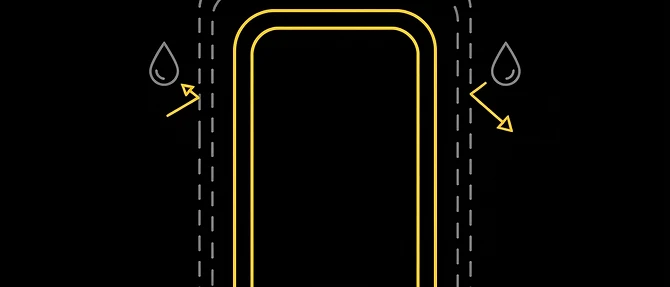 Conceptual diagram · not project documentationIPX7 documentation · team recordWaterproofing in use · animated documentationHead assembly · exploded documentation
One new use case can change the engineering requirements of the entire product.
Key statement · wet-use engineering · Gizmospring
12 / The quiet feature
Technology Should Support the Experience — not Become the Story.
BLISS incorporated ion emission intended to help smooth hair. The team’s documentation states it exactly that far: “ION emission smoothens hair.” That is the full extent of the published engineering claim — and the full extent of this account.
Ion emission · team documentationEverything behind that single sentence is engineering the public record doesn’t contain. These are the areas a complete account of the ion feature would cover — each one open until the team supplies it:
Ion-generation architecture
How are the ions actually generated inside the device?
Open · pending the project team
Output specification
At what rate and distribution does the emitter operate?
Open · pending the project team
Electrode placement
Where does the emitting surface sit relative to the bristles and the hair path?
Open · pending the project team
Safety requirements
Which standards govern an ion-emitting personal-care device?
Open · pending the project team
Power architecture
What does the emitter draw, and from which supply?
Open · pending the project team
Interaction with wet use
Both ion emission and IPX7 wet-use are documented. How the emitter behaves in the wet environment the product is rated for is unpublished.
Open · pending the project team
Validation performed
What testing, if any, verified the intended smoothing effect?
Open · pending the project team
No-claims boundary
No claim is made here about frizz reduction, hair health, static reduction, scalp benefits, or clinical efficacy — none is supported by published test data. The technology is presented exactly as far as the team documented it, and no further.
The technology mattered because of the user problem it was intended to solve — not because it added another feature to the specification.
Key message · the quiet feature · Gizmospring
13 / The business constraint
The Best Solution Still Has to Make Business Sense.
Gizmospring explored multiple accessory configurations and material combinations to find the strongest product solution — while remaining conscious of the client’s budget.
“We experimented with multiple accessories and material combinations to provide the best possible solution for our client, while keeping their budget in mind.”Verified · the team’s account
The exploration below isn’t a moodboard — every configuration was weighed against five trade-offs:
User value
Performance
Material
Manufacturability
Cost
Accessory explorationMaterial studyFinish direction studyComponent alternative · bristle interfaceComponent alternative · head assemblyDocumentation gap — pending the project team
The five axes mark what the exploration was weighed against — not published outcomes. Specific rejected alternatives are described only if verified by Gizmospring; none are documented in the public record, and none are invented here.
Product innovation isn’t finding the most elaborate answer. It’s finding the best answer that can actually become a viable product.
Key statement · the business constraint · Gizmospring
14 / The journey, retraced
From Product Description to Product Strategy.
The project didn’t begin by styling the client’s idea. It began by making sure we were solving the right problem.
Supporting statement · the BLISS journey · Gizmospring
Each stage existed to de-risk the next: the brief was reviewed for viability before design, research redefined the specification before engineering, and exploration stayed conscious of the budget — so the final product was the strongest answer the client could actually produce.
- 01Client idea
- 02Viability review
- 03Research & observation
- 04User pain points
- 05Redefined specification
- 06Accessory & material exploration
- 07Industrial design
- 08Engineering
- 09CMF
- 10Final product
15 / Outcome
A Comb Became a Platform.
BLISS evolved from an initial product description into a more versatile hair and scalp-care device — verified across the project record, and claimed no further.
Interchangeable bristle components
Ion functionality
IPX7 wet-use capability
Material & accessory optimization
Visual language aligned with NION
Verified · project documentation
 Fig. 17 · Final product · project documentationFig. 18 · Final product in motion · project documentation
Commercial & technical outcomes — populated only when verified
No production, market, clinical, testing, sales or subsequent-generation results are published in the public record. They are stated here only if Gizmospring verifies them — none are invented.
Documentation boundary
The project record titles the product a "plasma comb" and states that it was proven by clinical trial — but the underlying study is not public. This case study therefore makes no hair-growth, scalp-health, antimicrobial, therapeutic or clinical claims. Those are published only if and when Gizmospring provides the actual trial and confirms what it supports.
The biggest change wasn’t what we added to the product. It was how much more clearly we understood the problem before we built it.
Closing statement · BLISS outcome · Gizmospring
One Brief, Reframed. Eight Capabilities, Applied.
BLISS shows the full arc: from listening to the client, through engineering-led viability review and user research, to a specification negotiated into a manufacturable product for NION.
Have a brief that deserves a harder question?
Start a conversation